Introduction
“I have no experience” feels like a full stop. It is not. Employers hiring for entry-level roles and internships already know you will not arrive with years of professional history — university career offices at schools such as Penn and MIT say so plainly, and tell students to expect training on the job. What the hiring manager is reading for is evidence: can this person do the kind of work this role needs, learn quickly, and show up reliably? That evidence can come from coursework, class projects, volunteering, part-time work, clubs, and personal projects — anywhere you took responsibility and something happened as a result.
A cover letter with no experience is therefore not an apology. It is a short, specific argument: here is the job, here are two things I have actually done that match it, and here is why I want to do that work at your organization. This guide gives you the structure, four annotated example paragraphs — one for each kind of evidence — and the mistakes that sink otherwise good letters.
The structure: hook, evidence, fit, close
Keep the letter to three or four short paragraphs, about 200 to 300 words, on a single page. Use the same font and formatting as your resume, with your contact details at the top, the date, and the hiring manager’s name when you can find it — “Dear Ms. Castillo” beats “Dear Hiring Manager,” and “Dear Hiring Manager” beats “To Whom It May Concern.” The four parts below are the whole letter; nothing else needs to be in it.
1. The hook (paragraph 1, two to three sentences). Name the role, where you found it, who you are right now, and your strongest match in one sentence. Lead with the most relevant thing you have done, not with the fact that you are applying.
2. The evidence (paragraphs 2 and 3, one skill each). Pick the two must-have skills from the job posting and give one concrete example for each, from different parts of your life: the situation, what you did, and what happened — with a number, a tool, or a scope whenever you honestly have one. Two strong examples beat four vague claims.
3. The fit (one or two sentences, usually inside paragraph 3 or the close). One specific reason you want this employer — a program, a team, a value you can point to on their site or in the posting — not a generic compliment.
4. The close (paragraph 4, two to three sentences). Restate your fit in one line, say when you are available, thank the reader, and ask for the interview plainly.
Before you write: find your evidence
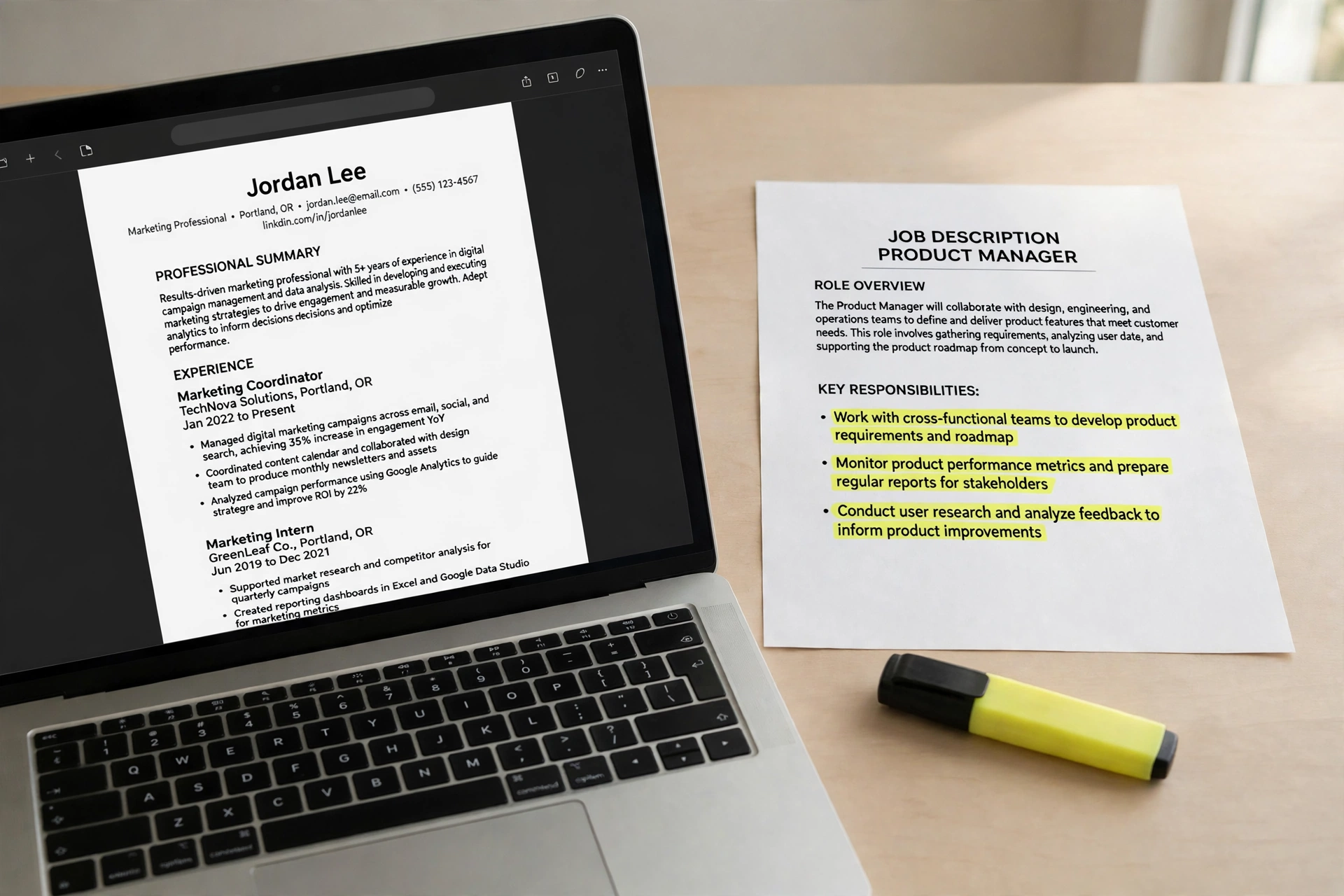
Read the job posting and highlight two must-have skills — the ones repeated in the responsibilities section, not the nice-to-haves. Then, for each skill, ask: where have I already used this, even outside a job? The honest answer usually comes from one of these places:
| Skill the job asks for | Where you may already have it |
|---|---|
| Communication | Class presentations, tutoring, answering questions at community events, a student publication |
| Organization and coordination | Group projects, club treasurer or secretary roles, scheduling volunteers, running a small event |
| Data and analysis | Coursework with spreadsheets or surveys, a capstone, tracking inventory for a family business |
| Customer service | Part-time retail or food-service work, front-desk shifts, helping visitors at events |
| Writing and research | Essays, research papers, a blog or portfolio, social media for a student organization |
| Reliability under pressure | Balancing a part-time job with classes, meeting deadlines for a team deliverable, covering shifts |
If a skill has no honest example behind it, do not claim it. Pick a different skill from the posting that you can prove. A letter built on two true examples is stronger than one built on five invented ones.
Example paragraphs, annotated
Each paragraph below is written for a fictional applicant and a fictional job. The annotation after it explains why the sentences work, so you can rebuild the same shape with your own facts.
1. Coursework as evidence
“In my business communications course, I prepared customer-response scenarios for a local company’s complaint-handling process and presented our team’s proposal to the class. The assignment required us to draft replies that were accurate, polite, and consistent with the company’s policy — and to revise them after feedback from our instructor and classmates. That work gave me practical experience handling the exact kind of customer messages your Customer Support Assistant role deals with every day.”
Why this works: it names a real course and a real task, and maps directly to the job’s requirement — drafting customer replies. The detail about revising after feedback shows the applicant can take direction, which is what an employer hiring someone with no experience most wants to know. It does not claim the coursework was a job, and it does not say “I am a fast learner” without proof — the proof is the work described.
2. A class project as evidence
“For my final marketing project, I worked with three classmates to research a local bookstore, analyze its social media activity, and build a six-week content plan. I was responsible for the research and the posting schedule, and I tracked which post types drew the most responses so we could adjust the plan in week three. The project taught me to plan content around evidence rather than guesses, and to keep a shared schedule on track when four people are contributing to it.”
Why this works: the scope is concrete — three classmates, one real business, six weeks — and the applicant’s own responsibility is separated from the group’s work. “I was responsible for the research and the posting schedule” is the sentence that matters; a hiring manager cannot tell what you did inside a group project unless you say so.
3. Volunteering as evidence
“At the campus food pantry, I rebuilt the intake spreadsheet in Google Sheets and staffed the checkout desk for two semesters, serving an average of 55 families per shift. Reorganizing the intake form cut the average checkout time from about six minutes to about three. Your Operations Assistant posting mentions queue management and accurate record-keeping, and that is the system I maintained week after week.”
Why this works: volunteering becomes job evidence when it is described like a job — a task, a tool, a volume, and an outcome. The numbers are the kind you can honestly know: how many families per shift, how long checkout took before and after. The final sentence does the tailoring explicitly, connecting the experience to the exact words in the posting instead of leaving the reader to make the connection.
4. Part-time work as evidence
“As a part-time cashier at a neighborhood grocery store, I handled cash and card payments, answered questions from customers, and resolved small complaints — a wrong price, a missing item — without calling a manager unless the issue needed one. Balancing twenty hours a week on the register with a full class schedule taught me to stay calm and accurate when the line is long and the pressure is on. I would bring that same steadiness to the front desk of your clinic.”
Why this works: a job that looks unrelated to the target role is reframed around the skills that transfer: handling money accurately, dealing with the public, solving small problems independently, and showing up reliably while studying. It also answers the unspoken question behind every no-experience application — will this person actually turn up and cope? — with a fact (twenty hours a week alongside classes) rather than a promise.
What not to write
Some sentences actively hurt a no-experience letter, however honest they feel:
- Do not open with an apology. “Although I do not have any professional experience…” tells the reader to focus on the gap before they have seen any evidence. Start with what you have done instead.
- Do not list traits without proof. “I am a hard worker, a fast learner, and a team player” is a claim anyone can make. One example that shows hard work is worth a paragraph of adjectives.
- Do not repeat your resume. The letter’s job is to explain why two or three experiences matter for this role, not to restate every line of the resume. If a sentence adds no new information, cut it.
- Do not flatter the company generically. “Your company is a leader in its field” could be written about any employer. One specific reason — a program, a team, a value — proves you looked.
- Do not write about what the job will do for you. “This role would be a great opportunity for me to learn” is true, and it is also entirely about you. The letter should be about what you can do for them.
- Do not pad. With less to draw on, padding is obvious. A tight 250-word letter with two strong examples reads far better than a full page of general claims.
Proofread twice — once for typos, once by reading the letter aloud. A cover letter is also a writing sample: Harvard’s career office says the letter demonstrates communication skills, attention to detail, and professionalism before a recruiter ever looks at the resume. A single typo in a short letter stands out.
Tailoring the letter to each job
Tailoring a cover letter is faster than tailoring a resume, because only a few sentences change:
- Swap the hook. The role title, the employer, and your strongest match change with every application.
- Swap the evidence. Keep a small bank of four or five example paragraphs — coursework, project, volunteering, part-time work — and pick the two that match each posting’s must-have skills.
- Swap the fit sentence. One specific reason for this employer, drawn from their site or the posting itself.
- Mirror the posting’s language. If the ad says “customer communication,” use “customer communication” in your letter, so the reader can map your evidence to their requirement without effort.
If you use an AI tool to help draft, treat it as a drafting aid, not an author. Ask it to tighten a paragraph you wrote from your own facts, and check every sentence against what you actually did. Our guide to writing better ChatGPT prompts shows how to ask for that kind of editing without letting the tool invent achievements, and our guide to free AI tools for students covers the free options if you are still studying.
A short template you can reuse
Dear [hiring manager’s name or Hiring Manager]:
I am applying for the [job title] position at [employer]. I am [a student at / a recent graduate of / what you are doing now], and [one sentence on the most relevant thing you have done].
Your posting asks for [skill 1]. [Where you used it — a class, project, club, volunteer role, or part-time job.] [What you were responsible for, how much or how often, and what happened.]
You are also looking for [skill 2]. [A second example from a different part of your life.] [The result, or what you learned from it.]
I want to work at [employer] because [one specific reason]. I am available [days, hours, or start date], and I would welcome the chance to discuss how I can contribute to your team. Thank you for your consideration.
Sincerely,
[Your full name]
FAQ
How long should a cover letter be with no experience?
About 200 to 300 words, in three or four short paragraphs, on a single page. You have fewer examples to draw on, so a tight letter with two strong ones reads better than a full page of general claims.
Should I mention that I have no experience?
No — not as an apology or an opening line. Write about the times you have used the skills the job needs, wherever that happened. The reader can see from your resume that you are early-career; the letter’s job is to show what you can already do.
What if I have no volunteering or part-time work either?
Coursework and class projects count. A group project, a presentation, a research paper, or a personal project — a portfolio site, a blog, a small coding project — all provide evidence if you describe the task, your part in it, and the result.
Do I need a cover letter if the application says it is optional?
Yes, when you have no experience. The resume alone shows a short work history; the letter is where you explain why your coursework, projects, and other experience still make you a credible candidate.
The bottom line
You do not need a job history to write a convincing cover letter — you need two true examples and a clear structure. Pick the two must-have skills from the posting, match each one to something you have actually done in a class, a project, a volunteer role, or a part-time job, and describe it with a task, a scope, and a result. Add one specific reason you want this employer, keep the whole letter under 300 words, and proofread it twice. That is the entire letter — and it is enough.