Quick answer: You do not always need a packaged supplement. Three simple preparations from an ordinary Indian kitchen cover three very common gaps: a seed-and-date ladoo for hair nutrition, a roasted besan (gram flour) protein drink that needs no protein powder, and a ragi–sesame calcium powder you stir into milk for bone support. Below are the ingredients, the method for each, and — just as important — the limits of what food can and cannot do.
These three recipes were recently brought together in one video by the health creator Fit Tuber (“3 Powerful Homemade Supplements”), and the ingredient lists below follow the ones he shared publicly with that video. The methods and explanations here are written in our own words, with realistic expectations added — because a ladoo is food, not medicine, and it should be talked about that way.
Why homemade, at all?
Packaged supplements have their place, but they also come with long ingredient labels, added sugars, and flavors you did not choose. A homemade preparation flips that around: you know every ingredient, you control the sweetness, and the cost per serving is a fraction of a branded jar. The trade-off is honesty about scale — food delivers nutrients in food-sized amounts, works slowly, and supports your normal diet. It does not replace a diagnosis or a treatment.
With that clear, here are the three preparations.
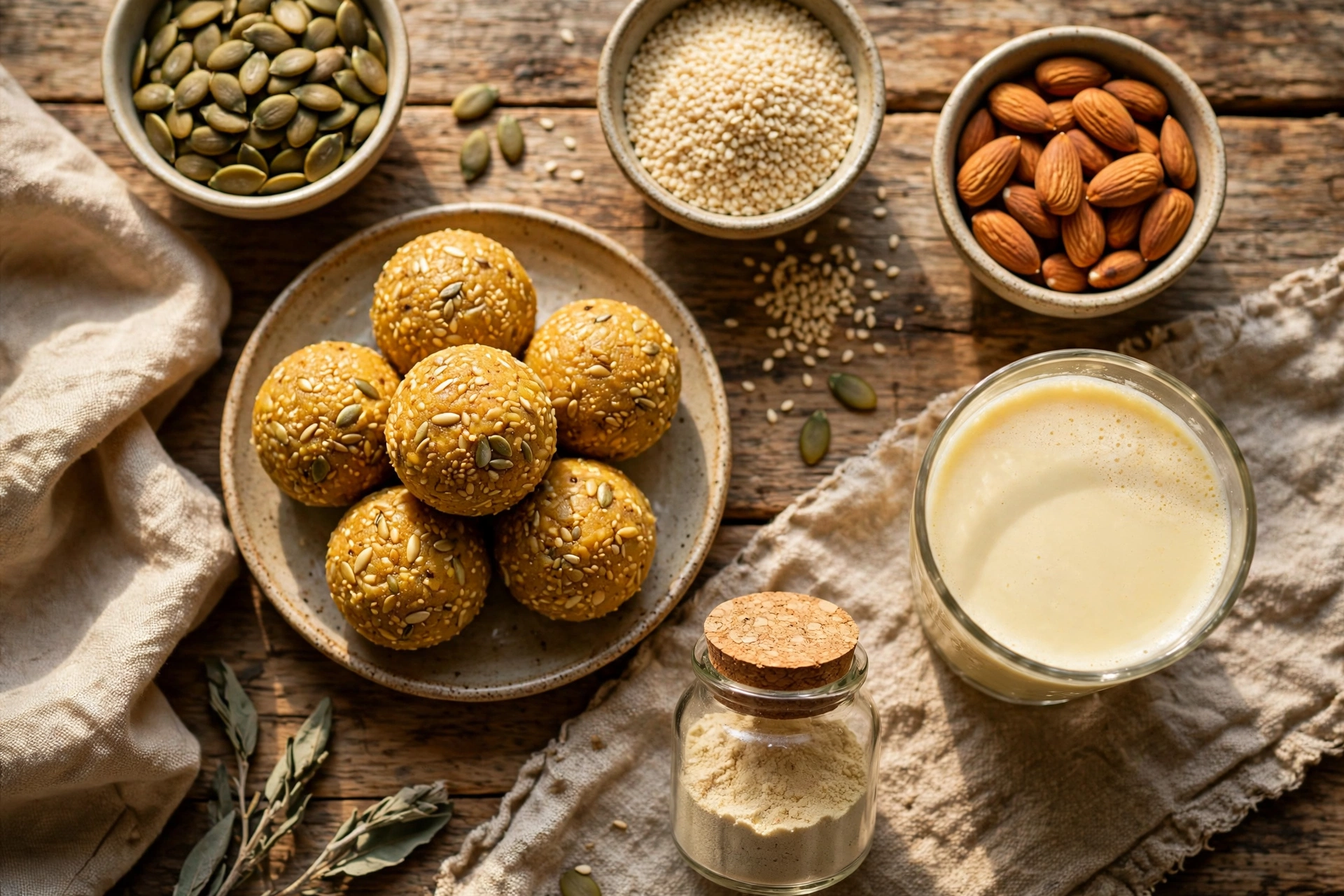
1. Hair Ladoo — a daily seed-and-date bite
This ladoo targets the nutritional side of hair health: seeds are natural sources of zinc, iron, healthy fats, and plant omega-3s, all of which play a role in normal hair growth, and amla adds vitamin C, which helps your body absorb iron from plant foods.
Ingredients (as shared with the video):
- Pumpkin seeds
- Sunflower seeds
- Flaxseeds
- Halim seeds (also called aliv or garden cress seeds)
- Desiccated coconut
- Dates — or jaggery, if you prefer it to dates
- Amla powder
Method:
- Dry-roast each seed separately on a low flame until it turns aromatic and just begins to color. Seeds burn fast — keep them moving and take them off early rather than late.
- Let everything cool completely. Warm seeds ground into a paste will release their oil and turn the mixture greasy.
- Grind the roasted seeds to a coarse powder. A little texture is a good thing here.
- Blend the dates into a thick paste (a splash of warm water helps). If you are using jaggery instead, melt it into a light syrup.
- Mix the seed powder, desiccated coconut, and amla powder into the date paste, then roll into small ladoos with greased palms.
- Store in an airtight jar. One ladoo a day as a snack is a sensible portion — these are energy-dense, and more is not automatically better.
Keep expectations straight: shedding some hair daily is normal, and persistent heavy hair fall, sudden bald patches, or severe dandruff can have medical causes — thyroid problems, iron-deficiency anemia, hormonal issues — that no ladoo will fix. Eat the ladoo for its nutrition; see a doctor for a diagnosis if hair fall is heavy or sudden.
2. The 27-Gram Protein Drink — no protein powder
The clever part of this drink is that its base is roasted besan — the same family as sattu, the roasted gram flour drink North India has relied on for generations. Gram flour is naturally protein-rich for a plant food, and milk does the rest.
Ingredients (as shared with the video):
- Besan (gram flour)
- A little ghee (the video suggests A2 cow ghee)
- Dry ginger powder (saunth)
- Milk
Method:
- Roast the besan in a teaspoon of ghee on a low flame, stirring constantly, until it turns golden and smells nutty. Raw besan tastes unpleasant and sits heavy — this roasting step is the whole recipe, so do not rush it.
- Let the roasted flour cool for a few minutes.
- Whisk it gradually into a glass of milk (warm or room temperature), a spoon at a time, so it does not form lumps.
- Add a pinch of dry ginger powder and sweeten lightly if you wish. Drink it fresh.
About that “27 grams”: the protein total depends entirely on how much flour and milk you use, so treat any single number as an estimate, not a guarantee. As a rough guide, about 75 g of besan whisked into 300 ml of milk lands in the region of 25–27 g of protein — which is the range the video designs this drink around. A smaller glass gives proportionally less, and that is fine for a snack-sized serving.
3. Ragi–Sesame Calcium Powder — one spoon in milk
Calcium is the nutrient adults most commonly under-eat, and two traditional ingredients do the heavy lifting here: sesame seeds, among the richest plant sources of calcium, and ragi (finger millet), a grain long valued in India for the same reason.
Ingredients (as shared with the video):
- Ragi flour (freshly milled, if you can get it)
- Almonds
- Black sesame seeds
- White sesame seeds (unpolished)
- Makhana (fox nuts)
- Chhuhara (dry dates)
- Saunth (dry ginger powder)
Method:
- Dry-roast the sesame seeds until they splutter and smell nutty; roast the makhana until crisp; lightly roast the almonds. Roast the ragi flour separately on a low flame until its raw smell disappears.
- Cool everything fully, then grind together with the dry dates into a fine powder. Stir in the dry ginger powder last.
- Store in a clean, dry, airtight jar, away from moisture.
- To use: stir one spoon of the powder into a glass of warm milk, once a day.
A necessary caution: this powder supports calcium intake as part of your diet. Ongoing joint pain, a suspected calcium or vitamin D deficiency, or bone pain is a reason to get a blood test and medical advice — vitamin D status, in particular, decides how much calcium your body can actually use, and no kitchen powder can tell you yours.
Three habits that make all three work better
Roast low and slow. Every recipe above depends on roasting, and every one is ruined the same way — high heat, scorched seeds, bitter powder. Low flame, constant stirring, off the heat early.
Grind in small batches. These preparations store for a few weeks, not months. Make what your household will finish in two to three weeks, keep jars airtight and dry, and make a fresh batch rather than a giant one.
Watch the portion, not just the recipe. Ladoos bound with dates and powders stirred into milk are nutritious and calorie-dense. One ladoo, one glass, once a day is the pattern that fits a normal diet — doubling the portion doubles the calories long before it doubles the benefit.
Frequently asked questions
Are homemade supplements as effective as packaged ones?
They serve a different purpose. Packaged supplements deliver standardized, concentrated doses; homemade preparations deliver nutrients as part of real food, along with fiber and healthy fats. For everyday nutritional support, food-first is a reasonable approach. For a diagnosed deficiency, follow medical advice on dosage — food alone may not be enough.
How long before I see any difference?
Hair and bone health change slowly, over months, not days. Judge any of these preparations over eight to twelve weeks of consistency, alongside sleep, overall protein intake, and the rest of your diet — not by the first week.
Can children and older adults have these?
The ingredients are ordinary foods, but portions and suitability still depend on the person — allergies (especially to nuts and sesame), diabetes (dates and jaggery are sugars), and medications all matter. When in doubt, check with your doctor first, particularly for children, pregnancy, or any ongoing treatment.
Where can I watch the original video?
These three preparations were featured in Fit Tuber’s video, 3 Powerful Homemade Supplements, on his YouTube channel — worth watching if you want to see each preparation made step by step.
Bottom line
A seed ladoo, a besan protein drink, and a ragi–sesame powder will not perform miracles, and any article that promises you they will is selling something. What they genuinely offer is simpler and more valuable: real nutrients, from ingredients you chose, at a cost almost any kitchen can afford — provided you keep the portions sensible and treat ongoing symptoms as a reason to see a doctor, not just to eat another ladoo.
This article is general information about food and nutrition, not medical advice. It is not a substitute for diagnosis or treatment by a qualified professional.