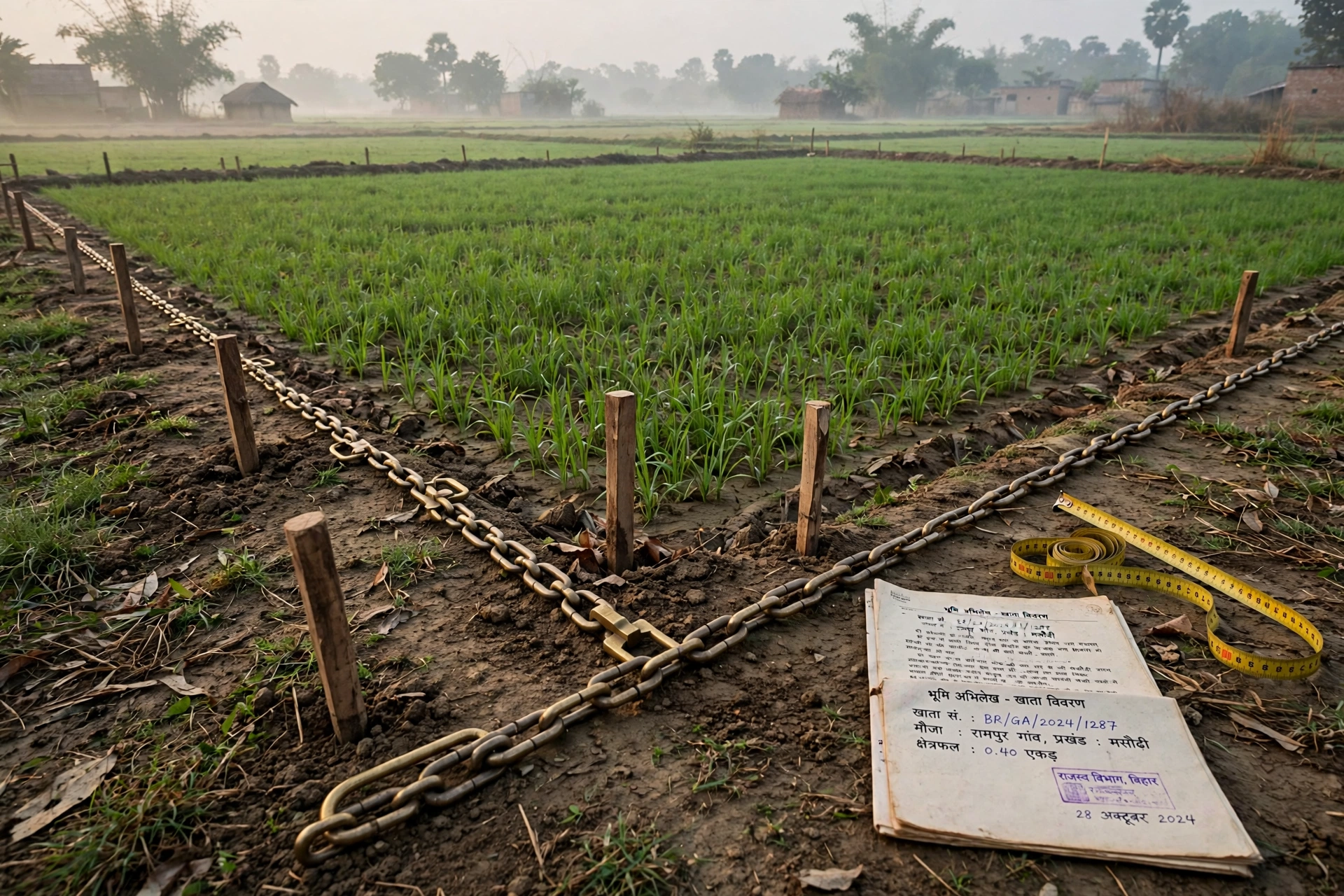
The Dhur is the unit Bihar’s land deals are actually negotiated in — and the one that causes the quietest mistakes, because it is small enough that nobody double-checks it. In Bihar, 20 Dhur = 1 Katha, so converting Dhur to Decimal only needs one extra step: knowing which Katha rate your area uses. This guide gives you both rates, a full table, and worked examples.
For the larger units, see our guides to Katha to Square Feet in Bihar and Bigha to Katha, or use the Katha to Decimal converter for instant results.
Quick answer
- 1 Dhur = 0.17075 Decimal at the common practical rate (1 Katha = 3.415 Decimal), and 1 Dhur ≈ 74.38 sq ft.
- 1 Dhur = 0.15625 Decimal at the Patna/Arrah revenue standard (1 Katha = 3.125 Decimal), and 1 Dhur ≈ 68.06 sq ft.
- 20 Dhur = 1 Katha; 400 Dhur = 1 Bigha; 1 Dhur = 20 Dhurki.
Dhur to Decimal conversion table
| Dhur | Decimal (3.415 rate) | Decimal (3.125 rate) |
|---|---|---|
| 1 | 0.171 | 0.156 |
| 2 | 0.342 | 0.313 |
| 5 | 0.854 | 0.781 |
| 10 | 1.708 | 1.563 |
| 20 (1 Katha) | 3.415 | 3.125 |
| 40 | 6.83 | 6.25 |
| 100 | 17.075 | 15.625 |
| 200 (10 Katha) | 34.15 | 31.25 |
| 400 (1 Bigha) | 68.3 | 62.5 |
Values rounded to three decimals; the unrounded rate is 0.17075 (or 0.15625) Decimal per Dhur.
The formula
Decimal = Dhur × (Decimal per Katha) ÷ 20
Or in one step: Decimal = Dhur × 0.17075 (practical rate) or Dhur × 0.15625 (revenue standard).
Reverse: Dhur = Decimal ÷ 0.17075 (or ÷ 0.15625).
Worked examples
Example 1: A plot of 50 Dhur. 50 × 0.17075 = 8.54 Decimal at the practical rate. At the revenue standard, 50 × 0.15625 = 7.81 Decimal. The plot did not change — the rate did. On a per-Decimal price, that gap is real money, which is why the rate belongs in writing on every measurement note.
Example 2: Convert 12.5 Decimal back to Dhur. 12.5 ÷ 0.17075 ≈ 73.2 Dhur (about 3 Katha 13 Dhur) at the practical rate. At the revenue standard: 12.5 ÷ 0.15625 = exactly 80 Dhur (4 Katha). Round numbers appearing on one rate and not the other is a handy clue to which standard a document was written in.
Example 3: The Dhurki level. 1 Dhurki = 1/20 Dhur = about 0.00854 Decimal (practical rate) or 0.00781 Decimal (revenue standard). Dhurki appears in old deeds; treat any Dhurki figure with the same rate question as Dhur.
Why small units cause big disputes
A one-Dhur error sounds trivial. But boundary disputes in Bihar routinely turn on a Dhur or two along a long edge, and a measurer using the other rate adds a second, invisible error on top: at 100 Dhur, the two rates already differ by 1.45 Decimal — roughly 632 sq ft. Whenever a measurement is redone and the area changes, ask first which rate was applied before assuming the land itself was mismeasured.
Frequently asked questions
How many Decimal in 1 Dhur in Bihar?
0.17075 Decimal at the common 3.415 rate; 0.15625 Decimal at the Patna/Arrah 3.125 standard.
How many Dhur are in 1 Decimal?
About 5.86 Dhur at the practical rate (1 ÷ 0.17075), and exactly 6.4 Dhur at the revenue standard (1 ÷ 0.15625).
How many square feet is 1 Dhur?
About 74.38 sq ft (practical rate) or 68.06 sq ft (revenue standard).
Is the Dhur the same in West Bengal and Assam?
No — the Katha it divides differs by state (720 sq ft in Bengal, about 2,880 sq ft in Assam), so their Dhur sizes differ too. This table is for Bihar only.
Which rate should my sale deed use?
The rate in the plot’s existing records and the district’s revenue practice. If a fresh measurement uses a different rate than the deed, resolve that difference before registering, not after.
Bottom line
Dhur to Decimal is one multiplication — Dhur × 0.17075 or × 0.15625 — but the answer is only as good as the rate behind it. State the rate on the document, and the smallest unit in Bihar’s system stops causing the biggest arguments. For Katha-level conversions, use our Katha to Decimal converter.